
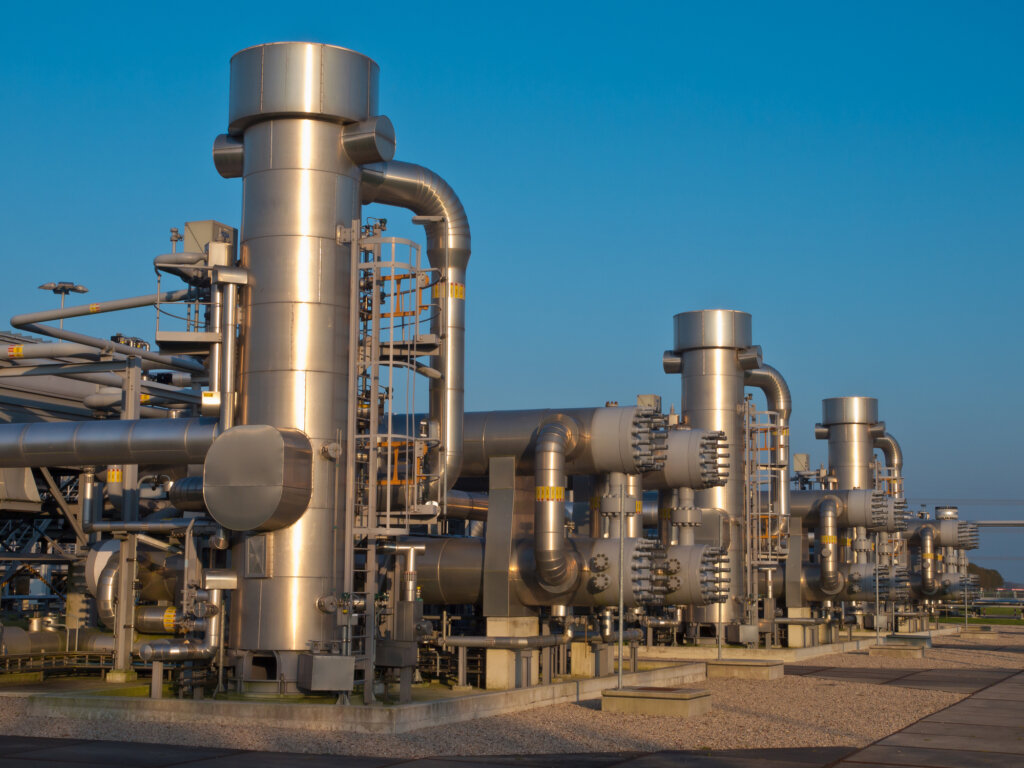
- How Synthetic Oil Is Made From Natural Gas
- Syngas Generation Operating Conditions
- Why Fischer-Tropsch Catalyst Fines Destroy Valve Seats
- Design Requirements for GTL Severe Service
- Material Selection for Heat and Abrasion
- Sealing Technology That Holds Up in GTL Service
- What a Valve Failure Costs in a GTL Plant
- Installation and Maintenance Best Practices
- Where to Start on Reliability Upgrades
- FAQs
Key Takeaways
- Auto-thermal reforming syngas outlet temperatures commonly reach 1,800 to 2,000°F (980 to 1,095°C), well past the safe operating range of standard ball, gate, and globe valves.
- Iron and cobalt catalyst fines from Fischer-Tropsch synthesis act like sandpaper, scoring conventional sealing faces and opening leak paths that no amount of actuator torque will close.
- Extended bonnets, hard-faced renewable seats, and live-loaded packing extend valve life and cut fugitive emissions in GTL service compared with standard designs.
- Renewable seat technology lets plants refurbish a valve in place instead of replacing it, so effective service life extends across multiple turnarounds.
- A single unplanned valve failure in a GTL synthesis loop can cost $100,000 to $500,000 per day in lost production, which is what justifies severe service hardware on reliability alone.
Producing synthetic oil from natural gas puts valves through two of the harshest environments in the process industries: syngas generation and Fischer-Tropsch synthesis. Outlet temperatures near 2,000°F, catalyst fines that behave like sandpaper, and constant thermal cycling defeat conventional valve designs in months rather than years. Synthetic fuels production only pays back when the hardware between the reactors runs as long as the catalyst does. This guide covers what actually happens to valves in Gas-to-Liquids (GTL) service, and which design features keep them sealing.
How Synthetic Oil Is Made From Natural Gas
Manufacturing synthetic oil from natural gas runs through three connected stages. Methane is first converted into synthesis gas, a mixture of hydrogen and carbon monoxide, usually through auto-thermal reforming. That syngas then passes through Fischer-Tropsch synthesis, which links carbon chains into liquid hydrocarbons. The raw products are finally cracked and upgraded into finished synthetic diesel, jet fuel, and base oils.
Each stage attacks valves in a different way. The first cooks them. The second sandblasts them with catalyst fines. The third cycles them until something gives.
For a plant manager, the constraint is rarely the catalyst. It is whether the hardware in the piping can keep up with it. Even a well-tuned Fischer-Tropsch loop will not pay back if the unit comes down every few months to replace destroyed valves.
Syngas Generation Operating Conditions
Auto-thermal reforming (ATR) drives the first stage of GTL production by partially oxidizing methane into hydrogen and carbon monoxide. Commercial ATR units run syngas outlet temperatures between 1,800°F and 2,000°F (980 to 1,095°C). Pressures up to 100 bar are common, which stacks mechanical stress on top of the thermal load.
High heat, high pressure, and thermal cycling together defeat conventional valve sealing mechanisms. What holds up in standard refinery service will not survive inside an ATR loop.
Syngas service valve challenges
- Outlet temperatures of 1,800 to 2,000°F (980 to 1,095°C)
- Thermal cycling during startups, shutdowns, and process upsets
- High-pressure operation up to 100 bar in commercial units
- A tight shutoff requirement for safe equipment isolation
- Exposure to soot precursors and reducing atmospheres
Standard globe, gate, and ball valves get overwhelmed in these conditions. Most of them depend on elastomeric components, soft seats, or static metal sealing faces. Once thermal expansion sets in, soft seats melt or extrude, metal sealing faces gall, and valve bodies warp. The outcome is either a seized valve or a gasket failure that lets superheated gas bypass the seal.
Why Fischer-Tropsch Catalyst Fines Destroy Valve Seats
The Fischer-Tropsch synthesis loop is where most GTL valves actually fail. The reaction requires metal catalysts, and those catalysts continuously shed micro-abrasive fines into the process media. Two operating regimes dominate industrial Fischer-Tropsch service.
| Regime | Operating temperature | Catalyst |
|---|---|---|
| Low-Temperature Fischer-Tropsch (LTFT) | 390 to 465°F (200 to 240°C) | Cobalt |
| High-Temperature Fischer-Tropsch (HTFT) | 570 to 660°F (300 to 350°C) | Iron |
The iron and cobalt particles released during operation behave like industrial sandpaper. They settle in piping and pack into any cavity they can find. When a conventional ball or gate valve cycles, the mechanical action traps those abrasive fines between the static sealing face and the seat, grinding them in instead of pushing them out.
What follows is rapid scoring of the metal, destruction of any soft sealing material, and a leak path that torque will not close. Catalyst abrasion in refinery pipelines is one of the most predictable failure modes in the industry, and it is why traditional valves rarely make it through more than a handful of cycles in serious Fischer-Tropsch service.
Design Requirements for GTL Severe Service
Valve designs that survive GTL applications address several failure modes at once. High-temperature capability calls for extended bonnets that keep packing zones cool, gasket materials that hold joint integrity through cycling, and structural alloys that resist creep during continuous high-temperature exposure.
The solids-laden process stream demands streamlined internal geometry that resists plugging and packing. Conventional gate valves, with their wedge-and-seat cavities, are ideal traps for catalyst fines, wax, and char. Rotating disc designs avoid the problem by providing a wiping action and a full-bore flow path that keeps particles from settling.
Critical GTL valve design features
- Extended bonnets that hold packing zone temperatures within safe limits
- Streamlined flow paths with no internal pockets for catalyst accumulation
- Hard-faced sealing surfaces that resist erosion from abrasive fines
- Metal-seated construction rated for continuous high-temperature service
- Live-loaded spring designs that hold sealing force constant through thermal cycling
Actuator protection matters just as much in ATR service. Process heat combined with radiant heat off hot piping will destroy a standard pneumatic actuator quickly unless it is shielded. Extended mounting brackets, heat shields, and forced-air cooling all keep actuator temperatures inside acceptable limits while still allowing maintenance access.
Material Selection for Heat and Abrasion
Material compatibility in GTL service balances high-temperature strength against abrasion resistance and cost. Body material selection generally follows the temperature at each position in the process.
| Body material | Practical temperature range | Typical GTL service |
|---|---|---|
| Carbon steel | Lower-temperature service | Cooler stages of the process |
| Chrome-moly F11 | Up to roughly 1,000°F | Moderate-temperature Fischer-Tropsch positions |
| Chrome-moly F22 | Up to roughly 1,100°F | Hotter Fischer-Tropsch and transfer lines |
| Austenitic stainless and high-nickel alloys | Approaching 2,000°F | ATR outlet and syngas service |
Trim selection has to answer temperature and abrasion at the same time. Cobalt-based hard-facing alloys such as Stellite hold up under elevated temperatures while resisting wear. For the most severe abrasion, tungsten carbide or ceramic inserts give better wear resistance, though their brittle nature means the surrounding design has to absorb thermal expansion without cracking them.
Sealing Technology That Holds Up in GTL Service
Reliable sealing in GTL service means moving away from conventional approaches. Soft-seated designs collapse quickly under abrasive fines and elevated temperatures. Standard metal-to-metal seats handle the temperature better but rarely reach the tight shutoff required for isolation without constant maintenance.
Advanced sealing systems use renewable hard-faced seats that combine durability with maintainability. Plants can refurbish the seat through resurfacing rather than replacing the entire valve, which stretches effective valve life across multiple turnarounds.
Live-loaded packing systems matter here too. Belleville washers or spring assemblies hold compression as the valve heats and cools, preventing the fugitive emissions and leaks that show up when conventional packing loses load.
What a Valve Failure Costs in a GTL Plant
The financial case for GTL valve selection runs well past the purchase order. A single unplanned shutdown caused by a valve failure in a GTL synthesis loop can cost $100,000 to $500,000 per day in lost production, which dwarfs the price difference between a standard valve and a properly engineered severe service valve.
Lifecycle cost analysis consistently favors premium valves in GTL service despite the higher upfront number. A standard ball or gate valve at $10,000 that needs replacement every 12 to 18 months from catalyst damage generates a large recurring expense in labor, parts, and downtime. A rotating disc valve that runs 7 to 10 years with periodic seat resurfacing delivers a far lower annualized cost.
Reliability also makes maintenance planning predictable. Scheduled refurbishment during a planned outage costs a fraction of an emergency repair with overtime labor and expedited parts, and fewer production disruptions feed directly into firmer customer commitments and revenue forecasting.
Installation and Maintenance Best Practices
Proper installation sets the foundation for reliable valve performance in GTL service. Pipe loads should never be carried through the valve body, since misalignment leads to binding and seal failure. Actuator sizing needs torque margin to handle rising friction as service progresses. Heat tracing and insulation call for real engineering so body temperatures stay stable while external components stay protected from radiant heat.
Maintenance procedures should take advantage of the renewable seat features that come with modern severe service designs. Running valves to failure costs more than refurbishing them during planned outages, both in dollars and in operational risk.
Maintenance best practices for GTL valves
- Run regular visual inspections for external wear and thermal damage
- Track actuator torque to flag rising friction before it becomes a stall
- Schedule seat refurbishment on cycle counts and operating conditions, not on failure
- Keep service records for each valve, including operating temperatures and cycle counts
- Stock critical spares including seats, packing, and actuator components
Where to Start on Reliability Upgrades
Upgrading critical valve positions in syngas generation and Fischer-Tropsch service delivers reliability gains and cost savings quickly. Priority belongs at the positions that have historically caused production disruptions, or where access for maintenance is difficult and expensive.
Everlasting Valve Company has built severe service process valves in South Plainfield, New Jersey since 1906, and has extensive experience in synthetic fuels applications. Our patented rotating disc valves are installed in major GTL operations worldwide. Sasol specifies Everlasting for catalyst slurry service in their Fischer-Tropsch process, and additional installations include Oryx GTL, Frontline BioEnergy, and the Energy & Environmental Research Center. Every design addresses the specific combination of extreme temperature, catalyst abrasion, and tight-shutoff requirements that defeats conventional valve technology in GTL service.
Contact us today to request a quote or speak with an expert.
Frequently Asked Questions
The Fischer-Tropsch process is a chemical reaction that converts synthesis gas, a mixture of hydrogen and carbon monoxide, into liquid hydrocarbons. It uses iron or cobalt catalysts to build the long-chain molecules that get refined into synthetic diesel, jet fuel, and base oils.
Ball valves fail in GTL service because their static sealing faces cannot handle high temperature, thermal cycling, and abrasive catalyst fines at the same time. Soft seats melt or extrude, metal seats gall and score, and trapped particles cut sealing surfaces on every actuation cycle.
Commercial auto-thermal reformers typically run syngas outlet temperatures between 1,650°F and 2,010°F (900 to 1,100°C), with most plants targeting 1,800 to 2,000°F. Those temperatures are too high for conventional valves with soft seats or static sealing faces.
A rotating disc valve uses a spring-loaded disc that rotates across its seat on every actuation. The motion shears catalyst fines off the sealing surface instead of trapping them, and the friction polishes both the disc and the seat so the seal tightens over time. That is why these valves are used for Fischer-Tropsch catalyst slurry service in major GTL operations.
Fischer-Tropsch synthesis uses either cobalt or iron catalysts. Cobalt catalysts work in low-temperature Fischer-Tropsch (LTFT) at 390 to 465°F (200 to 240°C). Iron catalysts work in high-temperature Fischer-Tropsch (HTFT) at 570 to 660°F (300 to 350°C). Both shed abrasive fines during operation that wear down conventional valves.